
Casting Technologies in Pump Bodies
Let’s be honest, most of us don’t spend our days thinking about pump bodies. We turn on the tap, water comes out, and life is good. But behind that simple miracle is a world of engineering marvel, and at the very core of it all is Casting Technologies in Pump Bodies. Think of it like this: if the pump is the heart of an industrial system, the body is the ribcage – it’s got to be tough, perfectly shaped, and reliable for a lifetime of beating.
This article is your backstage pass to how these metal workhorses are born. From the Casting of pumps for water pump systems that keep our cities hydrated to the mighty Heavy-duty pump body casting for industry, we’ll dive into the molten world of pump creation. And yes, by the end, you might just look at a fire hydrant with newfound respect. For world-class solutions in this field, consider Nex Holdings’ expertise.
So, why is casting so crucial? Simply put, it’s the most effective way to create the complex, hollow, and incredibly strong shapes needed to contain rushing water, aggressive chemicals, or scalding steam. A poorly cast pump body is a recipe for leaks, cracks, and catastrophic failure. That’s why foundries employ a variety of sophisticated pump casting technologies to get it just right. Whether you’re casually searching for ‘Casting of pumps for water pump near me’ or an engineer specifying Saudi standards-compliant pump casting, understanding these technologies is key.
The Classics: Sand Casting Pump Bodies
The Workhorse: Sand Cast Pump Bodies
When you think of metal casting, you probably picture a foundry worker shaping sand. You’re right! Sand cast pump bodies are the absolute backbone of the industry, and for good reason. This method is incredibly versatile and cost-effective, especially for medium to large parts. Imagine creating a precise, negative shape of the pump body in a special sand mixture. Then, you pour molten iron or steel into that cavity. Once it cools, you break away the sand, and voilà – you have a rough pump casing. It’s like the ultimate, high-stakes baking project, but instead of a cake, you get a component that might one day be part of a water and wastewater pump casting system.
However, not all sand is created equal. The traditional method uses green sand (which is actually blackish and damp). But for better surface finish and dimensional accuracy, many foundries have shifted to No-bake sand-cast pump bodies and Resin sand-cast pump casings. These use chemical binders instead of clay and water, resulting in a tougher mold that holds finer detail. This is a game-changer for creating complex internal passages that guide the fluid. So, whether it’s for a standard Industrial pump casing or a more specialized need, sand casting is often the first port of call.
Material Matters: From Iron to Steel
Now, what goes into that mold? The material choice is half the battle. Cast iron pump body manufacturing is a huge category, prized for its good machinability and vibration damping. But within iron, there’s a superstar: the ductile iron pump casing. This isn’t your great-grandfather’s brittle cast iron. By adding a pinch of magnesium, the graphite inside forms into spheres, making the material remarkably tough and flexible – imagine the difference between a piece of chalk and a bouncy ball. This makes it perfect for high-pressure applications, such as fire pump ductile iron casting, where failure is not an option.
For environments where rust is the enemy, Stainless steel pump body casting enters the chat. Think Pump body casting for desalination plants or handling certain chemicals. Stainless steel resists corrosion beautifully, but it’s trickier and more expensive to cast. And let’s not forget the oil and gas pump casting components, which often demand special alloys to withstand sour gases and extreme pressures. The point is that the Casting Technologies in Pump Bodies must be perfectly matched to the material being poured.
The Specialists: Precision and Heavy-Duty Casting
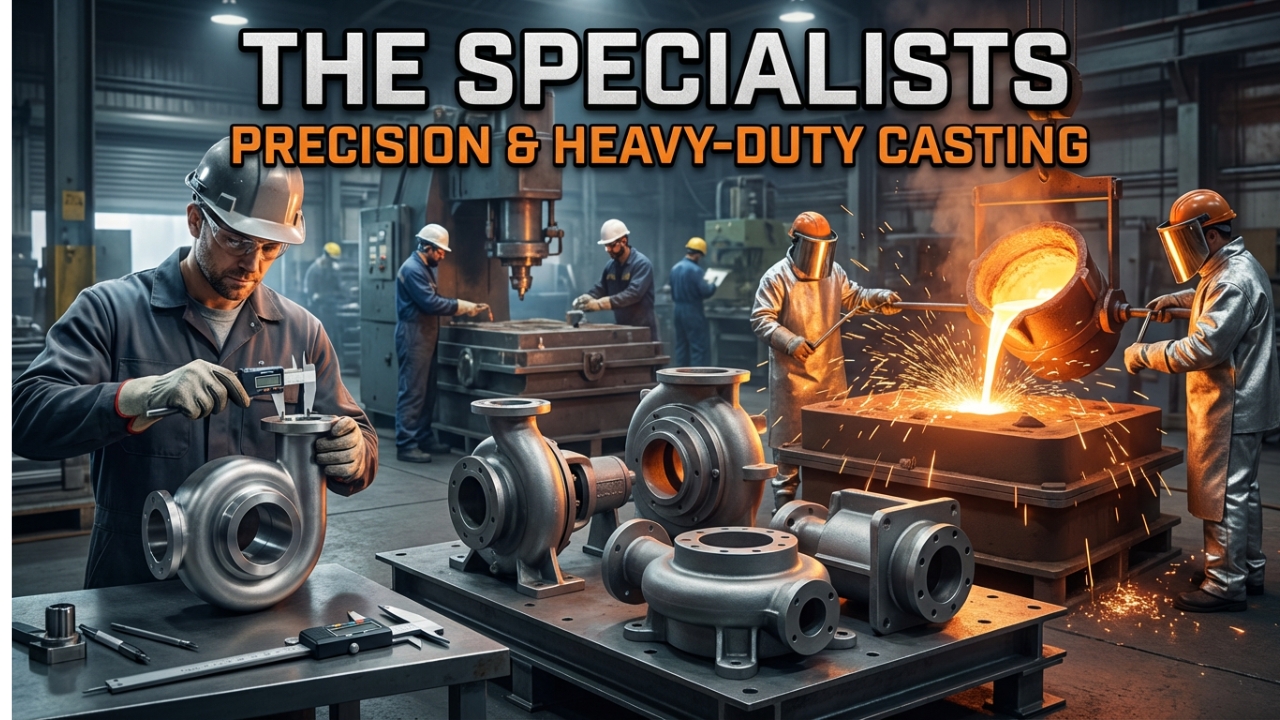
Casting Technologies
For the Detail-Oriented: Investment and Precision Casting
Sometimes, sand casting just isn’t precise enough. For pumps with intricate impellers, complex vanes, or super-smooth internal surfaces, foundries turn to investment-cast pump components. This process, also called the “lost-wax” technique, is as cool as it sounds. First, a wax model of the part is made. Then, it’s dipped in ceramic slurry to create a hard shell. The wax is melted out, and molten metal is poured into the ceramic mold. The result? Parts with excellent surface finish, tight tolerances, and intricate details that require minimal machining. It’s the go-to method for high-performance Precision pump casing casting.
Consequently, this technology is essential for industries where efficiency is measured in fractions of a percent. A perfectly smooth interior in an HVAC pump casing, for instance, reduces hydraulic friction, saving significant energy over the pump’s life. While it’s more expensive per part, the performance benefits and reduced machining costs can make it the most economical choice for critical components.
Going Big and Tough: Heavy-Duty and Large-Scale Casting
Now, let’s talk about the giants of the pump world. Some applications demand sheer size and strength. This is the realm of heavy-duty and large-diameter pump body casting. We’re talking about pumps that move millions of gallons for municipal water supply, flood control, or massive cooling systems in power plants. Casting something this large is a monumental task. Foundries use massive flask sizes and specialized sand systems to create molds capable of holding tonnes of molten metal.
Furthermore, these aren’t just big; they’re built to last under immense stress. They are the definition of Pressure-rated pump casing. The engineering behind these castings ensures uniform wall thickness, proper ribbing for support, and freedom from defects that could become failure points. Whether it’s for a major infrastructure project or a demanding Industrial pump casing application, mastering the Casting of these behemoths separates a good foundry from a great one. For projects requiring this scale and expertise in the region, you can reach out to us at +966 549 563 564 or info@nexholdings.sa.
The Right Fit: Application-Specific Casting
Meeting Standards and Resisting Elements
In the real world, pumps don’t operate in a clean, perfect lab. They face corrosion, abrasion, and often, very strict regulations. This is where Corrosion-resistant pump castings and standards compliance come to the forefront. A pump handling acidic wastewater needs a different material and casting approach than one pumping clean, cold water. Foundries must select alloys and processes that ensure the final product can survive its specific chemical bath.
Moreover, for projects in Saudi Arabia and the wider GCC, specifying pump castings compliant with Saudi standards is not just a good idea—it’s often a legal requirement. These standards (such as SASO) ensure that products meet local quality, safety, and performance benchmarks. It’s a critical checkmark for any serious project, guaranteeing that the Casting Technologies in Pump Bodies used have been validated for the region’s demanding conditions, from coastal desalination plants to inland industrial complexes.
Key Applications: Fire, Water, HVAC, and Energy
Finally, let’s connect the technology to the applications you see every day. Each sector has its own casting sweet spot.
-
Fire Protection: This is all about reliability. Ductile iron fire pump castings are dominant here, offering the perfect blend of strength, pressure rating, and cost-effectiveness. When the alarm sounds, this Casting must perform.
-
Water Infrastructure: This is the bread and butter. From the Casting of pumps for water pump stations to pump body casting for desalination, the demand is for durable, high-volume castings that can run for decades with minimal fuss.
-
HVAC Systems: Here, efficiency and noise are key. HVAC pump casing often focuses on precision to ensure smooth, quiet operation in office buildings and hospitals.
-
Oil & Gas and Energy: This is the high-stakes table. Oil & gas pump casting components must withstand brutal conditions. The castings are often in exotic alloys and undergo rigorous testing to prevent failures that could be both dangerous and astronomically expensive.
Conclusion: The Solid Foundation of Fluid Movement
In the end, the humble pump body, created through sophisticated Casting Technologies in Pump Bodies, is a silent guardian of modern life. From the water in your morning coffee to the climate-controlled air in your home, from the fuel at the station to the water that fights a fire, it all flows through a cast casing. The journey from a pile of sand and ingots to a Pressure-rated pump casing is a blend of ancient art and modern science. Whether it’s a Resin sand-cast pump casing for a municipal project or a Precision pump casing for a critical industrial process, the right casting method forms the very foundation of pump performance and longevity.
So, the next time you pass a pumping station or a large industrial plant, you’ll know there’s a world of molten metal and meticulous engineering inside. And if your project requires expertise in this crucial field, remember that companies like Nex Holdings are dedicated to mastering these very technologies. For a conversation about your specific pumping needs, don’t hesitate to contact us at +966 549 563 564 or via email at info@nexholdings.sa. After all, a great flow starts with a perfect cast.
FAQs on Casting Technologies in Pump Bodies
What exactly is meant by “Casting Technologies in Pump Bodies”?
- A: Think of it as the “recipe book” for making the tough, hollow metal shells that house a pump’s internal parts. Casting Technologies in Pump Bodies refers to the various methods—such as sand casting, investment casting, and others—used to pour molten metal into a mold to create a pump’s body or casing. The right technology ensures the final part is strong, leakproof, and capable of handling the specific job, whether it’s for a water and wastewater pump casting or a high-pressure fire pump.
I need a local supplier. How useful is searching for “casting of pumps for water pump near me”?
- A: It can be a great starting point! A local foundry reduces shipping costs and lead times for bulky items like sand-cast pump bodies. It also allows for easier site visits and better communication. However, don’t sacrifice quality for mere proximity. The best partner is one with proven expertise in Pump foundry casting technology, even if they are a bit farther away. For those in the region, companies like Nex Holdings offer both local expertise and international standards.
Why is Ductile Iron so common for pump casings?
- A: Ductile iron pump casing is the gold standard for many applications because it’s the “athlete” of cast metals. It combines the excellent castability and wear resistance of traditional cast iron with added strength and flexibility (ductility). This makes it incredibly tough and resistant to cracking under pressure shocks, which is why it’s mandatory for critical applications like Fire pump ductile iron casting.
What’s the difference between green sand and resin sand casting for pumps?
- A: It’s all about the mold’s binder. Traditional green sand uses clay and water, while resin sand-cast pump casings and no-bake sand-cast pump bodies use chemical binders. The resin-sand methods produce a much harder, more rigid mold. This results in a pump casing with superior dimensional accuracy, a smoother surface finish, and the ability to form more complex internal passages. It’s a step up for precision and performance.
When would I choose a stainless steel casting over a cast iron casting?
- A: You’d specify Stainless steel pump body casting when corrosion is your main enemy. If the pump is moving seawater (like in Pump body casting for desalination), harsh chemicals, or ultra-pure food-grade fluids, stainless steel’s resistance to rust and contamination is worth the higher cost. For standard water, wastewater, or general industrial fluids, cast-iron pump bodies or ductile iron are usually perfectly suitable and more economical.
What makes a pump casing suitable for “heavy-duty” or industrial use?
- A: A Heavy-duty pump body casting or an industrial pump casing casting is designed from the ground up for continuous, demanding operation. Key features include thicker, more uniform walls to withstand high pressure, strategic ribbing for extra strength, the use of premium materials such as ductile iron or special alloys, and rigorous non-destructive testing to ensure there are no hidden flaws. It’s built for 24/7 reliability, not just occasional use.
What does “Saudi standards compliant pump casting” involve?
- A: This means the pump casting and its manufacturing process adhere to the specific quality, material, and performance standards set by the Saudi Arabian Standards Organization (SASO) or other relevant GCC bodies. Compliance ensures the product is fit for the region’s unique environmental challenges (like heat and saline air) and meets all local regulatory and safety requirements for projects. It’s a critical certification for public and major industrial projects in the Kingdom.
Can you cast very large, one-piece pump bodies?
- A: Absolutely. Specialized foundries excel at casting large-diameter pump bodies. This involves using massive molding boxes (flasks), tons of specialized sand, and careful engineering to control the cooling of a huge volume of molten metal. These single-piece castings are essential for massive pumps used in flood control, major water supply intakes, and power plant cooling systems, where a welded assembly would be a weak point.
What is investment casting best for in pumps?
- A: Investment cast pump components are the go-to for complex, intricate parts that require “net-shape” or “near-net-shape” precision. Think of a pump’s impeller with its curved vanes, or small, complex valve parts. This process delivers excellent surface finish and dimensional accuracy, minimizing the need for expensive machining. It’s ideal for high-performance, high-efficiency pumps where hydraulic perfection is key.
How do I get started if I need a custom pump casing?
- A: Start by defining your application’s requirements: fluid type, pressure, flow rate, and material compatibility. Then partner with an experienced foundry that can advise on the best Casting Technologies for Pump Bodies to meet your needs. Share your drawings or specifications for a consultation. For expert guidance in the region, contact Nex Holdings at +966 549 563 564 or info@nexholdings.sa to discuss your Pressure-rated pump casing project.